
Champions Cup: Gotham defeated, Arsenal highlights disparities in women’s soccer
LONDON — The first FIFA Champions Cup semifinals unfolded in a partially filled GTech Stadium in Brentford, yielding two contrasting outcomes: Arsenal’s anticipated 6-0 rout of AS FAR and an unexpected result with Gotham FC’s 1-0 loss to Brazilian team Corinthians.
The unfortunate scheduling and organization of the event meant that the initial match, Corinthians vs. Gotham, was attended by groups of children on school excursions, accompanied by a vocal group of London Corinthians supporters. The 12:30 p.m. local kickoff time rendered it nearly impossible for many fans to be present.
The 6 p.m. kickoff for Arsenal-AS FAR posed similar challenges, as most individuals were leaving work around that hour. Nevertheless, a strong local Arsenal fan presence was evident, alongside a smaller group of Moroccan and AS FAR supporters scattered throughout the two open stands.
This competition, introduced in place of the Club World Cup, which has been postponed until 2028, is set to occur annually for the three years between each Club World Cup edition. With two teams currently out of season and a significant tournament scheduled every summer from 2027 onward, the timing and execution of a new tournament at an appropriate time is complex.
However, the prevailing sentiment among many is that, despite FIFA’s assertions of promoting women’s football, the competition feels hastily arranged, and those involved in the women’s game are divided on whether this approach truly fosters sustainable growth.
A surprising triumph for the underdog
The tournament was framed as a clash between the Concacaf champions, Gotham, and Arsenal, the European representative; the NWSL versus the Women’s Super League. Many anticipated that these two top-ranked teams, with significantly greater resources, would face off in the final.
Nonetheless, history was made when Gabi Zanotti, the 40-year-old captain of Corinthians, scored the decisive goal in the 83rd minute, surprising fans who had expected Gotham to advance easily.
Gotham appeared to be a team out of sync, managing only one of their 20 shots on target. While Corinthians also struggled at times, with two shots on target from nine attempts, Gotham’s extensive preparations (including a stay in Spain and matches against teams like Bayern Munich) did not translate into success against the speed and physicality of the South American champions. Their focus may have been more on a potential final against Arsenal rather than the immediate challenge posed by Corinthians.
By reaching the third-place playoff, Gotham will earn $200,000, but after incurring expenses for their European preparations, the NWSL team will ultimately incur a financial loss by participating in this competition.
Corinthians were also missing three players due to visa complications. This trio, regarded as among their best, could not travel to the U.K. until Sunday, missing the semifinal and leaving little time for the team to prepare cohesively.
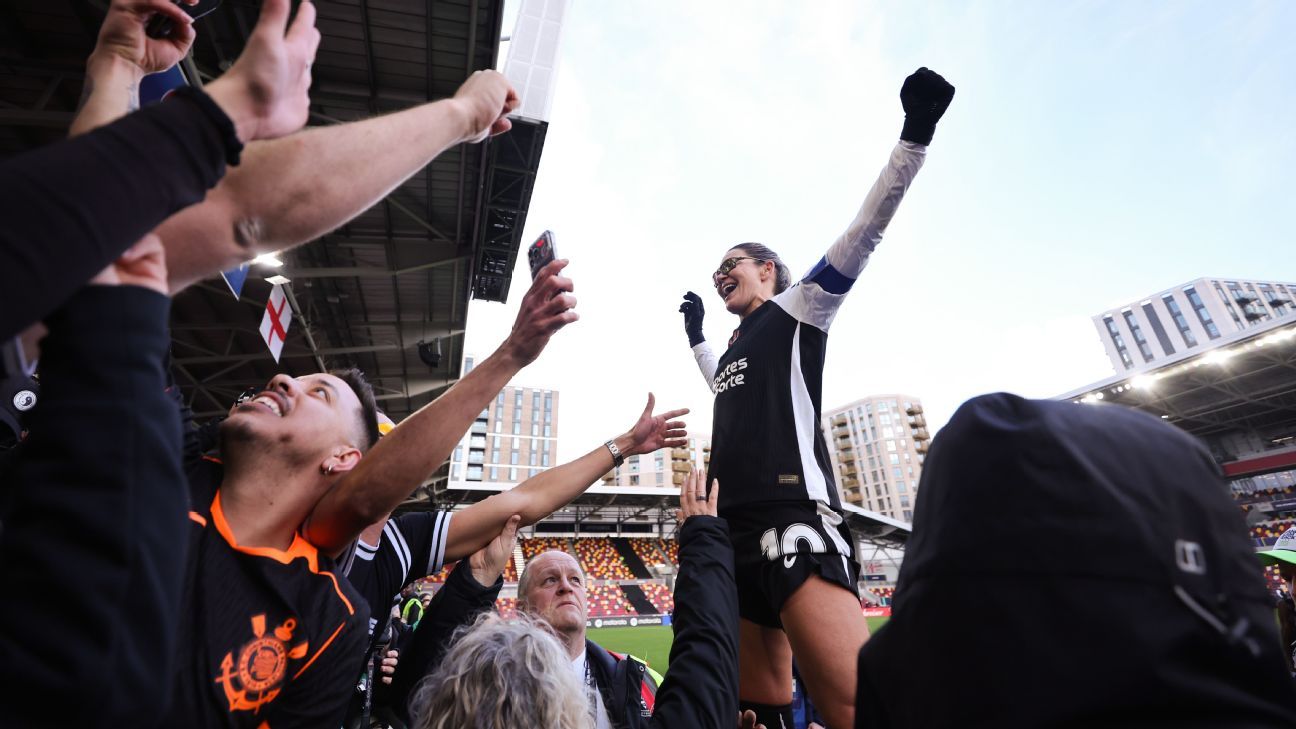
It is therefore unsurprising that the group of Corinthians fans, primarily consisting of London Corinthians supporters who filled one section of the mostly empty GTech Stadium, celebrated exuberantly at full time. They cheered, shouted, jumped, and waved black and white scarves in the air. Their enthusiasm was palpable during the match, but it reached new heights at the conclusion as the players joined in the festivities.
Zanotti was lifted into the air in front of the fans, relishing the recognition for her contributions to the club, leading them to the final and securing at least $1 million in prize money. This amount is guaranteed for simply reaching the final; they could potentially win $2.3 million if they defeat Arsenal on Sunday, a transformative sum for the club.
This victory serves as validation, demonstrating that Brazilian football clubs, despite having fewer resources compared to their North American counterparts, are equally capable and competitive.
Highlighting the disparity in women’s football
The outcome of the second match was likely more predictable, with Arsenal overpowering AS FAR, illustrating the significant gap between the two teams and the resources available to them.
Arsenal started strong, scoring four goals in the first half — one each from Stina Blackstenius, Frida Maanum, and Olivia Smith, along with a penalty from Mariona Caldentey — before substitute Alessia Russo added two quick goals within 10 minutes, bringing the score to 6-0. The statistics reflect the disparity between the teams: Arsenal had 21 shots, 10 on target, while AS FAR managed four shots with just one on target.
Arsenal, whose history predates the establishment of a league in Morocco, has developed resources, financial support, and a legacy, winning the Champions League in 2007 and again 18 years later to secure their place in this competition. They are arguably one of the best-funded and supported clubs.
AS FAR, while domestically dominant, having won every league title since 2015 and every Throne Cup since 2013, does not operate on the same level, nor do the confederations. European football remains one of the most affluent and advanced confederations, while women’s football in Africa is still developing.
This match was somewhat tilted in favor of Arsenal. Firstly, they did not have to travel far, unlike AS FAR, who faced a four-hour flight, reducing fatigue and naturally increasing local fan attendance. The visitors also arrived late on Monday due to visa issues.
The matches were relocated from the U.S. west coast because Arsenal is in the midst of their season, facing crucial title-deciding matches surrounding the competition. AS FAR is also in the middle of their season, but it was Arsenal who insisted on moving the games closer to home.
Arsenal has also been able to train at their own facilities, likely benefiting from resources that other teams may lack in this competition. FIFA will host the final at the Emirates, further enhancing the home advantage already experienced during the semifinals.
This marks the first occasion a team from Africa has faced a European club in a competitive match, creating history for both teams. AS FAR will receive $200,000 in prize money, much of which will offset travel expenses, but it is still viewed as a significant bonus and a means of gaining global recognition.
