
Barcelona and Real Madrid’s fragile agreement dissolves following Super League exit.
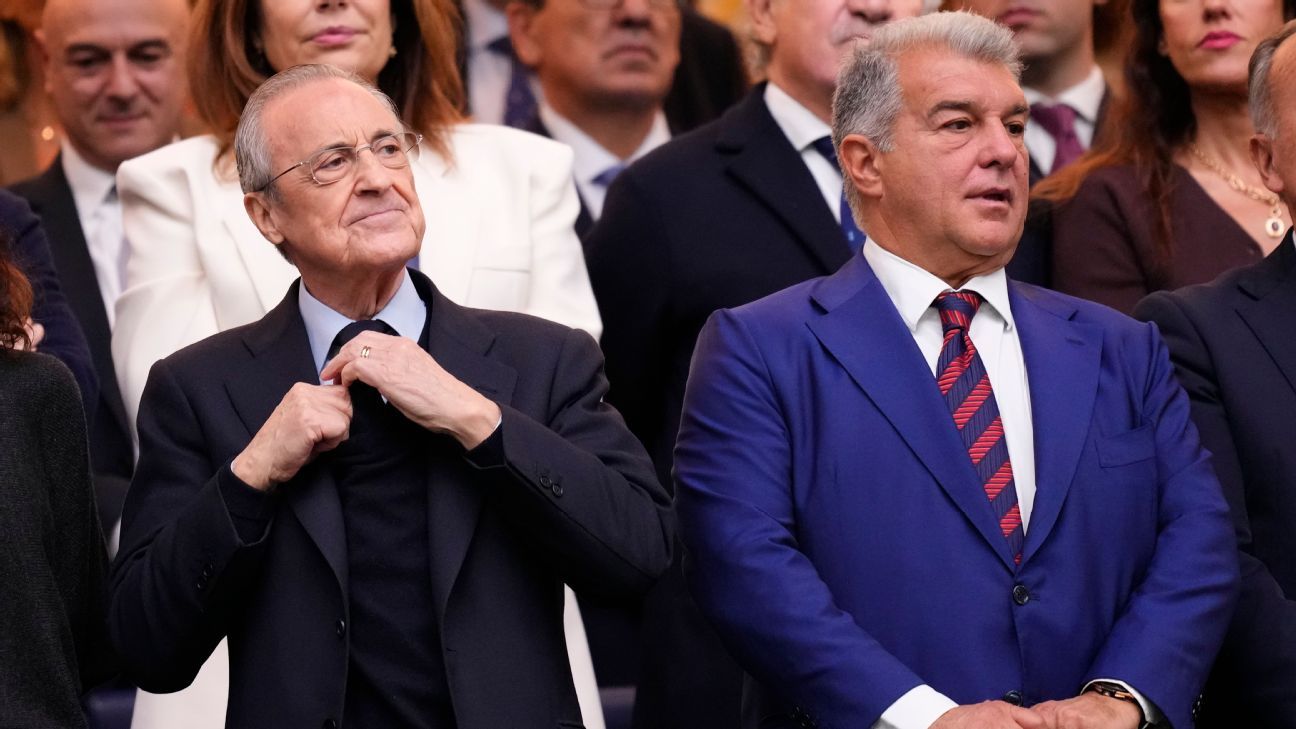
Nearly five years ago, several prominent soccer clubs in Europe united to declare their intention to create a separate European Super League, a plan that quickly fell apart.
LaLiga powerhouses Barcelona and Real Madrid were the last to hold onto the unrealistic hope of launching this lucrative competition, but on Saturday, Barça officially announced the termination of their participation in the failing initiative.
But why at this moment? And what implications does their delayed withdrawal have for the two Clásico adversaries and their standing in Spanish soccer? ESPN’s Madrid correspondent Alex Kirkland and Barcelona correspondent Sam Marsden provide an analysis.
– Stream every LaLiga match LIVE all season long on ESPN+ (U.S.)
– Real Madrid transfer inquiries: What to do about Vini Jr., Bellingham, Paz?
– NBA legends Kerr, Nash & Co. discuss the ups and downs of owning Mallorca
RIP, European Super League. Again.
As you may recall, 12 founding clubs joined the Super League upon its announcement in April 2021: six from the Premier League (Arsenal, Chelsea, Liverpool, Manchester City, Manchester United, and Tottenham Hotspur), three from LaLiga (Real Madrid, Barcelona, and Atlético Madrid), and three from Serie A (AC Milan, Inter Milan, and Juventus). Now, only Real Madrid remains. The six English clubs withdrew shortly after the project’s introduction, deterred by the overwhelming backlash. Atlético, Inter, and AC Milan followed suit soon after. Juventus took longer to exit, finalizing their departure in June 2024. On Saturday, Barcelona, in a 28-word statement, confirmed their exit as well.
Madrid’s solitude comes at a time when, in some respects, the concept of a Super League is more ideologically and practically viable than ever. In December 2023, the European Court of Justice (ECJ) ruled that UEFA’s prior regulations regarding breakaway competitions constituted an unlawful monopoly. In May 2024, a Madrid court, following that ruling, concurred that the sport’s governing bodies had misused their dominant position by threatening punitive measures against clubs that joined the Super League.
Meanwhile, Super League promoters A22 Sports Management introduced a new, more public relations-friendly model for the proposed competition, emphasizing its “inclusive and meritocratic” nature and announcing that matches would be streamed on a new, free-to-air service called Unify, funded by advertising. Recently, Madrid indicated they would pursue legal action to seek “substantial damages” from UEFA regarding its management of the Super League situation, referencing the ECJ and Madrid court decisions.
Just three months ago, Madrid president Florentino Pérez, a prominent advocate for the ESL and a vocal critic of UEFA, expressed at the club’s annual assembly that he was “more convinced than ever” of success in the Super League dispute.
“Real Madrid is the only club with the institutional strength and resources to engage in this battle,” he told club members. “Few are courageous enough to speak out. … We continue to assert that [the Super League] is a vital project for football. Our right to create our own competitions has been acknowledged. We can also claim multimillion-euro damages for UEFA’s actions. We possess two rights: to receive compensation for our losses and to organize a competition in the future, and we will relentlessly pursue both.”
While this is commendable, it leaves Madrid seeking a new, feasible competition to replace the Champions League as the sole official member. A22 CEO Berndt Reichart, the Super League’s articulate spokesperson, who has taken the lead as its public face since Pérez’s unsuccessful initial presentation on the late-night Spanish TV show “El Chiringuito” in 2021, contends that the project has more support behind the scenes than is commonly perceived.
Even UEFA acknowledged last October that a series of informal discussions had taken place with A22 to explore a potential compromise acceptable to both sides. The governing body of European soccer insisted that “no formal outcomes resulted from these discussions” and that “there are no plans to alter the format of the Champions League.”
When those negotiations concluded without success, Madrid made their demand for damages public. For the time being, with no other club besides Madrid expressing public backing for the Super League, that legal action will have to suffice as the extent of their ambitions. — Alex Kirkland
Madrid back on the offensive
The dynamic between Real Madrid and Barcelona has always been more intricate than it may initially appear. On the surface, the two Clásico rivals are fierce adversaries, yet there is also a recognition that, at times, they both rely on one another.
This has been particularly evident over the past five years as Madrid and Barça have united against UEFA and LaLiga on various matters, primarily arising from the unsuccessful launch of the European Super League in 2021.
That same year, both clubs, along with Athletic Club, rejected an investment proposal from private equity firm CVC into LaLiga. The league president, Javier Tebas, later claimed that if Barça had agreed to the deal, they could have prevented Lionel Messi’s departure. However, Barça president Joan Laporta believed the CVC agreement was not the solution to the Catalan club’s financial issues and preferred to align more closely with Madrid’s Pérez, who was at the forefront of the Super League initiative, and the potential revenue from the new competition.
This led to a temporary peace between the two clubs in the following years. Madrid even maintained a relatively low profile regarding their stance when the investigation into Barça’s payments to companies associated with José María Enríquez Negreira, the former vice president of the refereeing committee in Spain, first emerged in 2023. Madrid did join the case as a claimant, although this was largely perceived as a move to satisfy members rather than to fully condemn Barça for the payments, which totaled over €7 million between 2001 and 2018.
However, Madrid has intensified their scrutiny in recent months as it has become increasingly clear that they have lost Barça and Laporta’s backing for the Super League. In October, Laporta traveled to Rome, where he laid the groundwork for Barça’s return to the European Football Clubs (EFC), previously known as the European Club Association (ECA). Both Clásico clubs departed from the EFC when the Super League was announced. He has also strengthened relations with UEFA, LaLiga, and Tebas. Consequently, Madrid has redirected their attention back to the Negreira case.
“It is not normal for Barcelona to have paid over €7 million to the vice president of referees over 17 years,” Pérez stated at the club’s assembly last November. “That coincided with the most successful period in Barcelona’s history.”
Former Real Madrid coach Xabi Alonso also questioned the case in December, while new manager Álvaro Arbeloa chose to focus on the Negreira issue on Saturday when asked about Barça’s decision to withdraw from the Super League.
“Regarding the Negreira case: I think it is incomprehensible that the most significant scandal in Spanish football history remains unresolved,” Arbeloa remarked. “I believe this should concern many people.” — Sam Marsden
