
As Neymar reaches the age of 34, his aspirations for another World Cup are dwindling.
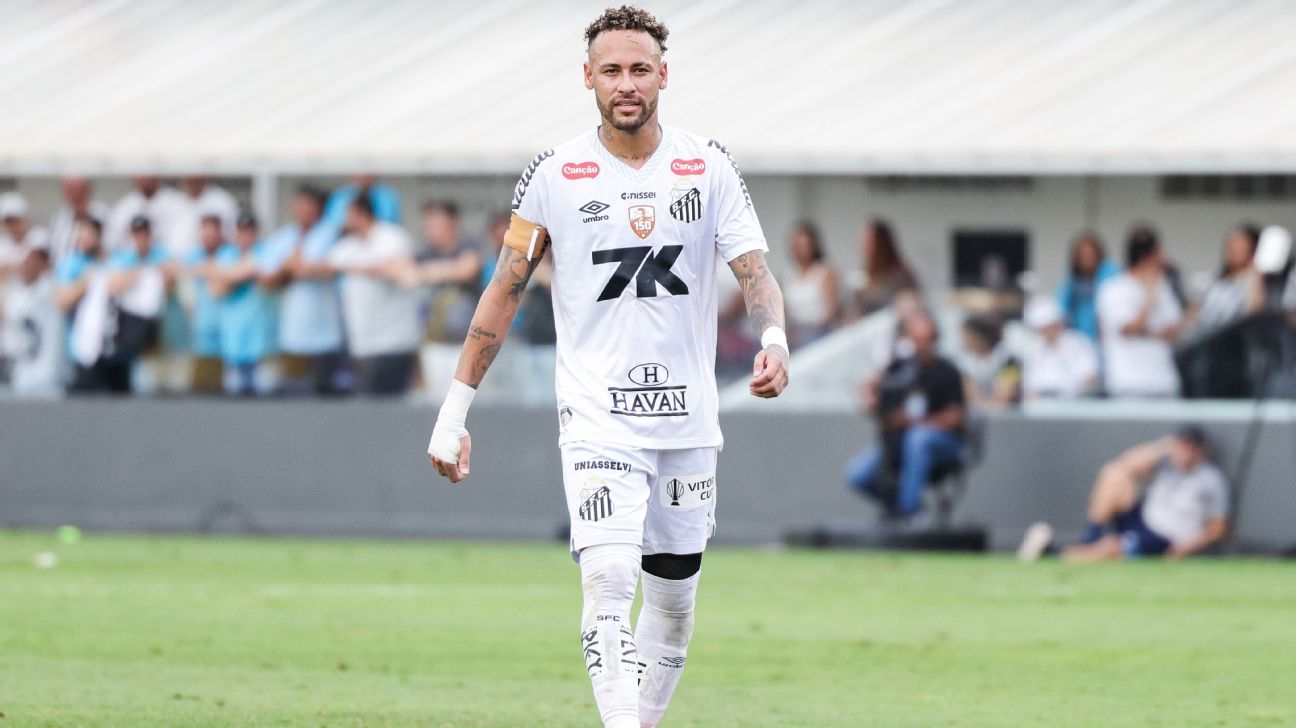
Neymar celebrated his 34th birthday on Thursday, Feb. 5, which may seem daunting for those who perceive the Brazilian icon as perpetually youthful.
However, for Neymar, another figure is even more concerning: the FIFA World Cup is merely 18 weeks away. This implies that he has approximately 15 weeks to secure a position in coach Carlo Ancelotti’s Brazil squad. It is a race against time, and Neymar must begin from a standstill.
Securing the World Cup trophy remains the primary aspiration of Neymar’s extensive, vibrant, and at times contentious career. Some may view it as his opportunity for redemption.
This perspective may appear harsh for Brazil’s all-time leading goalscorer, a player who has triumphed in both the UEFA Champions League and the Copa Libertadores, while also delivering numerous memorable moments of individual brilliance. Yet, in the eyes of the public — and perhaps even in his own perception — Neymar has not fully met the lofty expectations set for him.
– Lucas Paquetá returns to Flamengo in his prime. How did this happen?
– How has Palmeiras’ ‘Billion Generation’ fared in Europe?
– What are Vinícius Júnior’s options as his Real Madrid contract runs down?
In his defense, the expectations were exceptionally high. Over 15 years ago, Neymar embarked on a career that would be deemed disappointing if he did not secure both a Ballon D’Or and a World Cup. As for the first goal, that opportunity seems to have passed. However, he still holds onto the hope of making an impact in North America this summer. This aspiration has motivated him through extensive physiotherapy and rigorous training since suffering a significant knee injury while representing his country in October 2023.
Nearly two and a half years later, there remains no definitive proof that he has fully recovered. His return to Santos in Brazil last year became a prolonged source of frustration.
There is a belief that, with an eye on a national team recall last March, he pushed himself through too many matches too quickly and faced the consequences. With a series of injuries, Neymar was unable to gain any momentum. He can still strike a dead ball with accuracy and threat, and is capable of executing a good pass. But can he evade his marker and influence a high-level match? If so, he appears to be reserving that aspect of his game for 2026.
There was a glimmer of hope in the final days of the 2025 league season. Neymar postponed a minor knee procedure to assist Santos in avoiding relegation during the last three matches. The opponents? Two teams already relegated and another that fielded a reserve squad. Thus, it was nothing compared to the full intensity of a World Cup encounter.
Since then, he has been focused on recovering from that knee operation and regaining match fitness. He is now fully training, and the time for his return is nearing.
Fortunately, a restructuring of the domestic Brazilian calendar may have benefitted Neymar.
Managing the game has never been straightforward in a country as vast and diverse as Brazil. The history of Brazilian football is regional, with a distinct championship for each of the 27 states that comprise this large nation. However, the current reality is national. As the national league — which truly began in 1971 — has gained significance, the regional state competitions have gradually diminished in prominence. Thirty years ago, they occupied half the year. More recently, they have been limited to the initial months, with the national league commencing in early April.
If this were still the situation, Neymar’s task would be more challenging. With characteristic charm and public relations finesse, national team coach Carlo Ancelotti is making an effort to engage with domestic Brazilian football. However, it is likely that he harbors a European’s disdain for the regional competitions. He has certainly made it clear that Neymar’s case for a Brazil recall will be evaluated based on his performances in the national league. It is fortunate, then, that this year the league has started significantly earlier than usual.
The major kickoff occurred on Jan. 28. For a period, the national league is being played midweek, with weekends reserved for a condensed version of the state competitions. Thus, from the outset of his comeback, Neymar will have the opportunity to assert his claim in meaningful matches against formidable opponents.
There were expectations that he might return on Wednesday, the day before his birthday, in the second-round match at home against São Paulo. Ultimately, he was not risked. The decision was made to hold him back for the weekend. One of the risks of a shortened state championship is that any club easing into it like a preseason can find themselves facing the threat of a humiliating regional relegation. With seven games without a win across all competitions, Santos finds themselves in exactly this predicament, and will hope Neymar can help extinguish the crisis against relatively weak upstate rivals.
The true battleground, however, is the Brazilian league. Next Thursday’s third round will take Santos south to face Athletico Paranaense. Neymar may sit that one out. Athletico’s stadium features a synthetic pitch, which Neymar has been vocal against and may view as a risk for injury. The subsequent league match is a post-Carnaval encounter at home against Vasco da Gama — the very match where last year Neymar had to be assisted off the field, weeping in despair after an astonishing 6-0 defeat. It would be an appropriate setting from which to initiate a comeback.
And he must hit the ground running — not only because time is limited, but also because Ancelotti has emphasized the need for high standards. Neymar will need to earn his place in the Brazil squad. The veteran Italian coach has become accustomed to fielding inquiries about Neymar, and has utilized his responses to clarify the conditions for a recall. There will be no room for luxury players in the squad, nor for those who can only contribute 15 or 20 minutes sporadically.
“Modern football demands not only talent,” Ancelotti stated late last year. “But also physical condition and intensity. If Neymar deserves to be included, if he’s performing well and is superior to the alternatives, he will go to the World Cup. But only if he is at 100%, not 80%.”
Assuming Neymar can achieve fitness and readiness, where might he fit within the team? Ancelotti categorizes his attacking options into three types. There are the wingers — and Neymar is not among them.
“I believe he must play centrally,” the coach remarked. “Not on the wing, because in modern football, wingers must assist defensively.”
Then there are the No. 9 target-men center forwards, such as Richarlison, Igor Jesus, and Pedro of Flamengo. Again, this does not align with Neymar’s profile.
This leaves the false nine, or what Ancelotti perceives as a blend of a No. 9 and a No. 10 — a striker operating slightly deeper, providing a passing option for the players behind him, and offering options for those ahead. Barcelona star Raphinha could fit this role. Ancelotti is clearly a strong supporter of Matheus Cunha, the striker who has featured most during his brief tenure. Chelsea’s João Pedro is another serious contender.
The competition, therefore, is fierce — and may be intensifying. There could be a direct contest for a squad position between Neymar and Endrick, Real Madrid’s diminutive striker who has made a remarkable start to his loan period with Lyon.
Endrick is still only 19. He has time on his side. Neymar does not — he is 34. And this is now or never for one last opportunity at World Cup success.
