
Formula 1 announces regulatory adjustments ahead of Miami Grand Prix
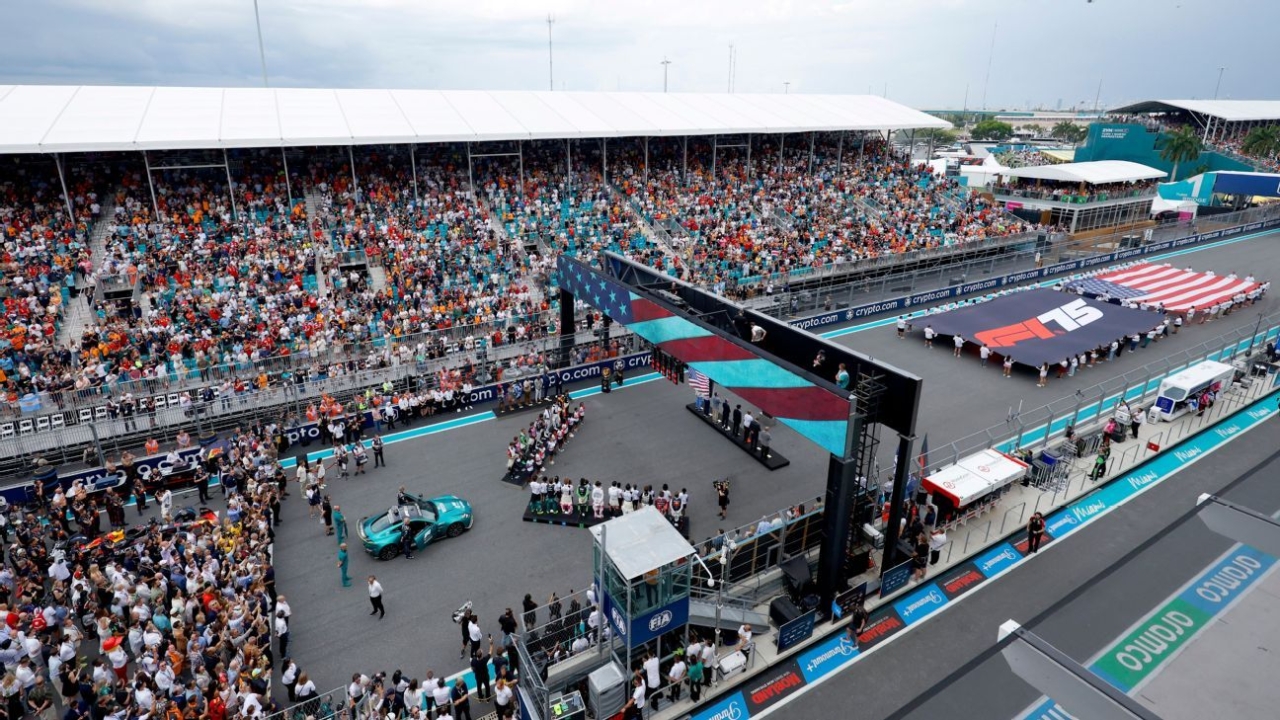
Formula 1 has consented to a series of rule modifications to tackle issues regarding its contentious new vehicles prior to the Miami Grand Prix on May 3.
This season, F1 experienced its most significant regulatory overhaul, which included the introduction of new V6 hybrid engines that feature an almost equal division between combustion and electric power.
This shift has resulted in an increased emphasis on battery usage and how drivers manage and utilize energy throughout a lap, leading to numerous challenges and a new driving approach that has not been well-received by many competitors and a considerable portion of the fanbase.
On Monday, F1 teams convened with the sport’s chief, Stefano Domenicali, along with prominent figures from the governing FIA to discuss these issues and implement adjustments ahead of the Miami Grand Prix on May 3.
Drivers have also been in dialogue with F1 and the FIA throughout this month.
On Monday evening, the FIA published a comprehensive list of modifications that will take effect for the race in Miami. Despite the extensive nature of the list, F1 has privately emphasized that these changes are minor adjustments to a set of regulations it continues to support.
It is still uncertain whether more substantial alterations to the regulations will occur before the 2027 season.
“The final proposals presented during today’s meeting were the outcome of a series of discussions over the past few weeks involving the FIA, technical representatives, and extensive feedback from F1 drivers,” stated an FIA announcement.
“Conversations regarding potential modifications were informed by data collected from the first three events of the 2026 season.”
Current world champion Lando Norris has remarked that the cars do not align with the aspirations he and his colleagues had when they envisioned racing in Formula 1. Four-time world champion Max Verstappen has described the new cars as “anti-racing,” comparing them to Mario Kart and to the all-electric series Formula E “on steroids.”
Verstappen has also suggested that he might consider leaving the sport entirely, primarily due to his dissatisfaction with the new vehicles.
Most concerningly, the challenges have not been confined to a single area, with issues now present throughout every aspect of an F1 weekend.
The extreme energy management required during qualifying has compelled drivers to ease off in corners that were previously taken at full throttle. The new cars have introduced a new term to F1’s vocabulary — super-clipping, which refers to the phenomenon where cars lose top speed when a driver’s foot is fully pressed down, as energy is redirected from the engine to the battery instead of the crankshaft.
Safety issues have also been raised, underscored by Oliver Bearman’s near-miss with Alpine’s Franco Colapinto in Japan, where the Haas driver approached the Argentinian’s car at a significantly higher speed and narrowly avoided a collision.
Teams and manufacturers have adopted varying strategies and software for deploying their power boosts, resulting in no uniform point where cars can access the speed increase.
Following the incident at Suzuka, Williams driver and Grand Prix Drivers Association chairman Carlos Sainz criticized F1 and the FIA for disregarding drivers’ safety warnings, as proponents of the new formula are enthusiastic about the new dynamic racing created by the battery boosts available to all cars on the grid.
Not all drivers oppose the new regulations — Lewis Hamilton has referred to the new cars as the purest form of wheel-to-wheel racing he has ever experienced in his illustrious F1 career.
– Wolff on F1 changes: ‘Act with a scalpel, not a baseball bat’
– Critics of new rules and regulations have ‘short memories,’ says F1 boss
– Russell: Enough ‘low-hanging fruit’ to enhance F1 regulations for Miami GP
There have also been challenges with race starts, attributed to significantly different turbo designs — Ferrari has achieved rapid starts while other manufacturers have lagged, raising safety concerns about potential collisions due to varying launch speeds. Teams have also expressed numerous concerns regarding possible issues during wet weather conditions.
Here are the FIA’s rule modifications in full, as stated in the governing body’s announcement on Monday.
Qualifying
– Modifications to energy management parameters, including a reduction in the maximum allowed recharge from 8MJ to 7MJ, aimed at minimizing excessive harvesting and promoting more consistent full-throttle driving. This adjustment targets a maximum superclip duration reduced to approximately 2-4 seconds per lap.
– Peak superclip power has been increased to 350 KiloWatts (kW), up from 250 kW, further decreasing the time spent on recharging and alleviating driver workload regarding energy management. This will also be applicable in race conditions.
– The number of events where alternative lower energy limits may apply has risen from 8 to 12 races, allowing for greater adaptation to circuit characteristics.
Race
– The maximum power available through the Boost in race conditions is now limited to +150 kW (or the car’s current power level at activation if higher), restricting sudden performance disparities.
– MGU-K deployment remains at 350 kW in critical acceleration zones (from corner exit to braking point, including overtaking zones) but will be capped at 250 kW in other sections of the lap.
– These measures aim to reduce excessive closing speeds while preserving overtaking opportunities and overall performance characteristics.
Race starts
– A new “low power start detection” system has been developed, capable of identifying cars with unusually low acceleration shortly after clutch release.
– In such instances, automatic MGU-K deployment will be activated to ensure a minimum level of acceleration and mitigate start-related risks without providing any sporting advantage.
– An associated visual warning system is being introduced, activating flashing lights (rear and lateral) on affected cars to alert following drivers.
– A reset of the energy counter at the start of the formation lap has also been implemented to rectify a previously identified system inconsistency.
Wet conditions
– Tyre blanket temperatures for intermediate tyres have been raised following driver feedback to enhance initial grip and tyre performance in wet conditions.
– Maximum ERS deployment will be reduced, limiting torque and improving vehicle control in low-grip situations.
– The rear light systems have been simplified, providing clearer and more consistent visual signals to enhance visibility and reaction time for following drivers in adverse conditions.
Source: espn.com
