
Alex Quinn Reflects on Hypercar Debut at Barcelona and Monza
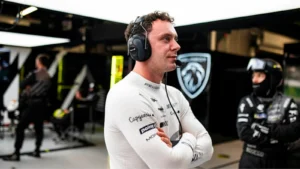
Alex Quinn’s advancement with Team Peugeot TotalEnergies led to his next milestone at the 6 Hours of Barcelona, marking his first appearance in a Hypercar. After his initial run at Barcelona, he discussed the shift to Hypercar racing in an interview with Motorsport Week during the 6 Hours of Monza.
Alex Quinn was initially scheduled to begin his full-time FIA World Endurance Championship campaign in 2027. Instead, his promotion to Team Peugeot TotalEnergies’ race line-up occurred sooner than expected, allowing the British driver to take the wheel of the team’s #93 Peugeot 9X8 for the last two rounds of the 2026 season.
The 25-year-old took over from Stoffel Vandoorne after the Fuji round, partnering with Nick Cassidy and Paul Di Resta for the Barcelona and Monza events. This was a major chance for Quinn, who had been serving as a test and development driver for Peugeot throughout the season while building his endurance racing credentials. His 2026 season had already seen significant achievements, such as winning the IMSA LMP2 championship and taking class wins at both the 24 Hours of Le Mans and the Rolex 24 at Daytona.
Moving into the Hypercar class was a crucial career step for Quinn. Because he had already worked with the team and got used to the 9X8, he could approach his debut with some preparation. Still, no amount of preparation could fully mimic the reality of racing in the championship.
Quinn viewed his Barcelona debut as a key moment in his career. “It was a really special weekend,” he explained. “It’s been nice looking back on my career and then finally having that first weekend come around.”
Joining the team went more smoothly than he had feared, largely due to the help of his colleagues. Even though he joined the line-up late in the season, Quinn stated that he never felt burdened by the new environment’s demands.
“Everyone in the team was amazing, helping me get settled in. It never once felt too much for me, so that was nice,” he said. “It felt like it was quite seamless.”
The outcome fell short of the team’s expectations, as the #93 failed to score points. Nevertheless, Quinn was more pleased with the progress made during the event and the chance to learn more about the car.
“We didn’t quite make the points, but I feel like throughout the weekend we made massive progress. In my stint, I enjoyed it and, looking back on it, I have no regrets. I feel like it was a really fun weekend.”
While his prior testing with Peugeot laid a good groundwork, the race weekend introduced new challenges. A major difference was dealing with traffic, especially when sharing the track with the LMGT3 cars. Quinn noted that this aspect of Hypercar racing is hard to reproduce in non-competitive settings.
“There are obviously some things you can’t fully prepare for. You can’t put yourself in that race situation until you’re actually in it. I’ve driven the car before in tests, and obviously I was a development driver this year, so I was prepared in that aspect.
“There are a few things, like being in GT traffic in this car, that you can’t really prepare for. But at the end of the day, I feel like we handled it well.”
Having completed his first race, Quinn had a better sense of what to expect at Monza. His early anxiety had faded, enabling him to focus on the weekend’s tasks rather than the weight of his debut.
“I feel like I’m less nervous, for sure. I didn’t admit it at the time, but I probably was quite nervous,” he admitted. Having now experienced the championship environment first-hand, he felt more comfortable and better prepared for his next outing. “I definitely feel more comfortable and ready to get on track.”
Monza was also a familiar track for Quinn. He had last raced there in 2020, securing pole position, but changes to the track surface and layout meant he still needed to adapt.
“It’s a track I enjoy. I was on pole here last time I was here, so I enjoy it, and I think the racing should be fun as well,” he said.
He was eager to experience the circuit under the pressure of multi-class endurance racing. Although he knew the track, driving a Hypercar among the LMGT3 field would bring new challenges.
“It’s a track that’s probably good for racing, good for overtaking and multi-class racing. It will be the first time I’ve done that here, so I’m interested and excited for the weekend,” he added.
Integrating into an established driver line-up was another key part of Quinn’s introduction to the championship, alongside adapting to the track and car. Working with more seasoned teammates helped him gain a deeper understanding of the 9X8’s technical details.
He specifically praised Nick Cassidy’s help, emphasizing how vital it was to grasp the systems and adjustments needed to run the car effectively over a race weekend.
“They’ve been amazing, to be honest,” Quinn said of his teammates. “They’ve been really good, really fun to work with and really helpful.” He singled out Cassidy for his support, explaining that the process of learning the car goes considerably further than simply driving it quickly.
“I feel like I have to give Nick a special mention. He’s been very good with me, helping me with all the systems in the car.”
Although Quinn had done development work and prepared for this moment, race weekends added another layer of complexity. Adapting the car, managing its systems, and making adjustments required a deeper understanding of the underlying engineering.
“When you’re actually in a race weekend and having to adapt and adjust the car, the systems and everything like that, he’s been really good at giving me the theory behind it so I fully understand it,” he explained.
This learning curve will extend beyond the final rounds of 2026. With a full-time program ahead, the extra track time at Barcelona and Monza gives Quinn a valuable chance to get comfortable with the championship before the next season starts.
“That’ll keep going this weekend, and I’m sure next year as well,” he said. “So, definitely learning a huge amount.”
Quinn is also aware that technical learning shouldn’t overshadow the main goal. Even though understanding the car and its systems is important, his primary focus remains on getting the best performance possible whenever he is driving.
“At the same time, it’s a race car and we still have to just drive it as quickly as we can,” he added. “The background is where the learning is happening.”
Looking toward 2027, Quinn has much to look forward to on the calendar. Silverstone will naturally be his home race, but he is especially excited about racing on unfamiliar circuits.
Fuji is one such circuit he has highlighted. “It’s a really cool calendar,” he said, pointing to the Japanese track as a particular highlight. “In terms of new tracks, I’m excited for Fuji. I feel like that’s going to be a cool place that I haven’t been to.”
For now, Quinn’s main focus is maximizing the opportunities with Peugeot in the season’s final stages. His early promotion gave him a head start in transitioning to Hypercar racing, but his approach remains focused on gaining experience, understanding the car, and continuing to improve.
Barcelona was the first chance to test that preparation. Monza offers another opportunity to build on it, with the long-term goal of arriving in 2027 better prepared for a full FIA WEC campaign.
