
Nothing Can Keep Cayden “Bubba” Herrera off the ice
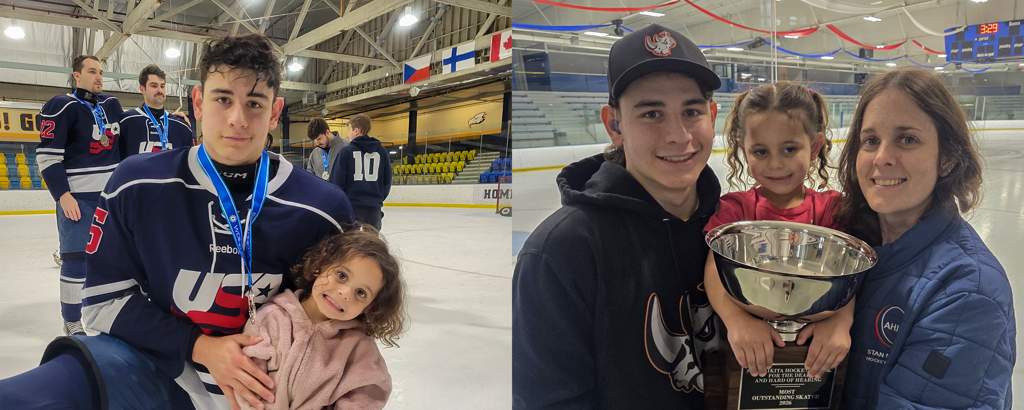
According to his mother, Cayden “Bubba” Herrera wasted little time getting onto the ice as a child.
In fact, she skated while pregnant with him.
“As soon as he started walking, when he was 18 months old, he was running out onto the ice,” Leah Gardner said. “He grew up in the ice rink. Every Friday and Saturday, we would take the kids to the ice rink.”
By the time he was 10, Herrera, a Las Vegas native, was already playing hockey.
“Hockey has been a game that has been in the family,” Gardner said. “[His] dad played.”
Nothing was going to keep Herrera off the ice — not even the fact that he had been born with severe hearing loss. Herrera just kept on moving up the ranks.
Last year, Herrera skated on the U.S. team that won a silver medal at the fourth World Deaf Ice Hockey Championships in Vancouver, British Columbia.
“I was really hungry for the gold medal,” Herrera said. “Representing Team USA means patriotism to me. When we won silver at Worlds, I was proud of what we accomplished, but it made me determined to do more.
“I got a piece of what it feels like to represent my country, and now I want another opportunity to do that.”
Herrera will get another chance to reach the top of the podium when he competes with the U.S. Deaf Ice Hockey Team at the 21st Winter Deaflympics held in Innsbruck-Seefeld-Tirol, Austria, from Jan. 15-24, 2027. The event is organized by the International Committee of Sports for the Deaf.
Deaf/Hard of Hearing Hockey follows USA Hockey rules but features visual aids that help players such as Herrera who have significant hearing loss. Many take part in youth, high school, college and junior hockey.
Herrera will play this season with the Willmar WarHawks (Minn.) of the North American 3 Hockey League. The WarHawks open their 2026-27 season Oct. 2 at the Minnesota Vulcans.
Herrera, now a 19-year-old, 6-foot-1-inch, 195-pound defenseman, uses hearing aids, knows American Sign Language, and speaks. His younger sister is also deaf.
“I’ve felt so welcome with the deaf hockey community,” said Herrera, who is part of the American Hearing Impaired Hockey Association (AHIHA).
The organization was founded in 1973 when the AHIHA Stan Mikita Hockey School for the Deaf and Hard of Hearing opened and hosted its first annual week-long camp.
“Our mission to achieve goals beyond hockey has propelled thousands of athletes who have gone on to achieve great success in their careers and personal lives,” wrote AHIHA president Kevin Delaney on the organization’s website. “With each new generation, we look forward to enriching and touching their lives with the same principles and commitment that launched this great association more than 45 years ago.”
To be effective and safe on the ice, Herrera had to adapt and compensate for his hearing loss over the years.
“Because Bubba couldn’t always hear coaches explaining new drills, he learned early on to rely heavily on visual observation,” Gardner said. “He would watch the drill being demonstrated, figure out what was expected, and then implement it.
“As he got older and more experienced, there were also times when he already knew the drill, and coaches would have Bubba demonstrate it for the other players.”
His junior season and the Winter Deaflympics are on his immediate horizon, but Herrera also hopes to one day play Division I college hockey.
Gardner credits the Las Vegas hockey community with helping Herrera develop as a young player.
“We’ve watched people pour into Bubba throughout his entire hockey life,” Gardner said. “Coaches, teammates, hockey families, friends and people throughout the Las Vegas hockey community helped the little boy we watched … become the player he is today.
“Now he has the opportunity to represent the United States at the Deaflympics. We want his village behind him, and we want to help build that same village around the rest of the team.”
Story from Red Line Editorial, Inc.

