
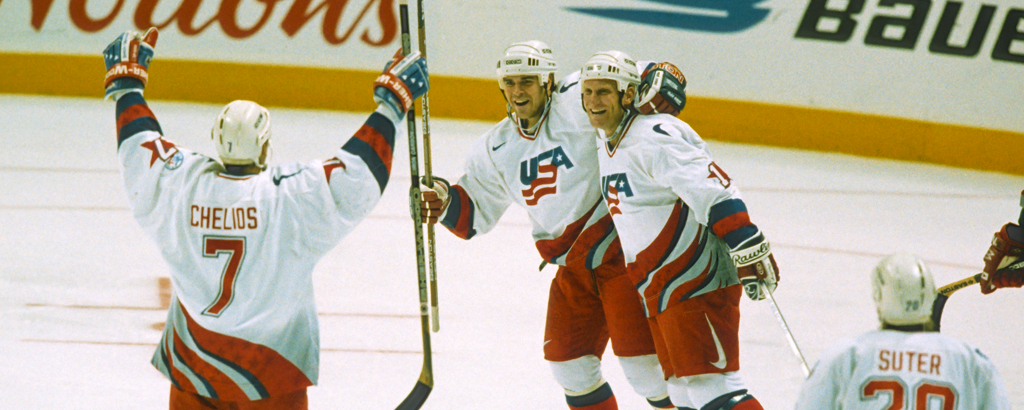
Three moments played a significant role in Team USA’s success at the inaugural World Cup of Hockey in 1996.
Only one of them happened on the ice, and it had nothing to do with the 37 goals the Americans scored in their seven games en route to a gold medal.
The first moment took place when the players reported to training camp in Providence, Rhode Island. With a team full of star NHL players, U.S. general manager Lou Lamoriello wanted to unite his players and made sure to outfit everyone with whatever U.S. gear they needed, keeping any NHL apparel in the suitcase.
“You had somebody coming in wearing a [New Jersey] Devils golf shirt,” said Mike “Doc” Emrick, who called the games on TV. “No, you didn’t want that. It was issued when they got together for the first time. Everybody got the various bits of gear that all had Team USA on it. But they were a unified group. That’s one thing that I recall.”
The next key moment came before the first game of pool play, which happened to be against Canada.
Coming off his third season as an NHL head coach with the Anaheim Mighty Ducks, Ron Wilson coached the U.S. team. While he didn’t have a prepared speech to give, he had a two-part message he thought would give the players a little extra juice.
Wilson compared the state of men’s hockey to riding a school bus. The Canadians were always driving the bus, with the Americans asked to sit near the back, rarely competing for medals in international events.
Wilson also asked his players how they would approach competing against some of their NHL teammates when they faced Canada. He cited Mark Messier’s commitment to doing anything to win a critical game. Would U.S. captain Brian Leetch do anything, including scrap with Messier, his New York Rangers teammate, with the game on the line? Same with John LeClair and Philadelphia Flyers teammate Eric Lindros, the 1995 Hart Memorial Trophy winner coming off a 115-point season in 1995-96. What would he do against the Flyers’ phenom if the U.S. and Canada were tied 2-2 in the final two minutes of a game?
Wilson knew what the Canadians would do. Now, he was trying to get that same extra effort out of the Americans.
“All those guys that he posed the question to, everybody in the room had to be thinking about what they would do, even [if] they didn’t have a teammate that was playing on Canada’s team,” Emrick said. “They had to at least consider the hypothetical question. It was just a collection of brilliant things.”
Given Wilson’s message, Keith Tkachuk chatted with Bill Guerin about picking a time to start a fight.
They didn’t set a concrete plan entering the opener against Canada in Philadelphia. But something struck Tkachuk just 20 seconds into the game and he dropped the gloves against Claude Lemieux. At the same time, Guerin fought Keith Primeau, but that was the undercard to Tkachuk-Lemieux. The scrap took place right in front of the benches and sent a message to both teams that the U.S. wasn’t going to sit in the back of the bus this time.
“Billy and I talked about it and we were just like, ‘All right, somebody’s fighting. Don’t fight at the same time.’” Tkachuk said. “But that backfired on us. It was great. The people loved it. The fans loved it. I mean, it got both teams jacked up and from there, I think we just took off.”
The move didn’t work initially, as Canada took a 2-1 lead into the first intermission. But the second period was a different story as Doug Weight and Scott Young scored to put the U.S. up 3-2. Brett Hull then scored a power-play goal 25 seconds into the third for a 4-2 lead. The Americans won 5-3, which earned them a bye into the semifinals.
Following a 5-2 win over Russia and a 9-3 win against Slovakia, the U.S. defeated Russia in the semifinals to set up the best-of-three final series against Canada.
The format had the first game back in Philadelphia, then the last two games in Montreal.
In Game 1, Theo Fleury scored midway through the third to put Canada ahead 2-1 before LeClair scored a stunner with seven seconds left in regulation to force overtime. However, Steve Yzerman scored the winner in overtime to provide Canada a prime chance to clinch gold on home soil.
The loss didn’t faze the Americans, though.
“We still were very confident that we could win that series [after losing Game 1],” Tkachuk said. “You had to just concentrate on the next game or else there wasn’t going to be a Game 3.”
The U.S. faced a hostile Canadian crowd in Game 2. But that might have inspired the tight U.S. team, which won 5-2 thanks to two goals from LeClair.
With one game for the championship, Team USA trailed 2-1 with a little more than seven minutes to play in regulation. The U.S., however, responded with a flurry. After Hull tied the game with 3:18 to play, the Americans scored three more goals to stun the Canadians and secure a 5-2 triumph.
U.S. goaltender Mike Richter earned tournament MVP honors with a 2.43 goals-against average and .920 save percentage while playing in six of the seven games. He stopped 35 of the 37 shots he faced in Game 3 to lift the U.S. to the championship.
“[In] Game 3, I thought, for the most part, they outplayed us, but we bent, we didn’t break and I think that’s when Mike Richter in that series really took his game to another level and basically single-handedly won that game,” Tkachuk said.
Tkachuk, who had five goals and an assist in the tournament, and Emrick, both noted the importance of this victory. The “Miracle On Ice” was 16 years in the rear-view mirror, leaving a generation of Americans without a significant U.S. international championship.
No one knew that it would be another 30 years before the U.S. men’s team would win another Olympic gold, so the World Cup of Hockey triumph remained a standout moment for American hockey fans for decades.
From the moment Lamoriello provided Team USA gear for everyone, the U.S. players formed a tight bond. Even 30 years later, the team’s camaraderie is what stands out the most for Tkachuk.
“We had so many different ingredients,” he said. “The best part about our team too, is on your own teams, you play in certain situations. Everybody understood [their roles for the U.S.]. There were no egos. Everybody got along. We had so much fun off the ice, not just on the ice. And I think that brought us together.”
Story from Red Line Editorial, Inc.
