
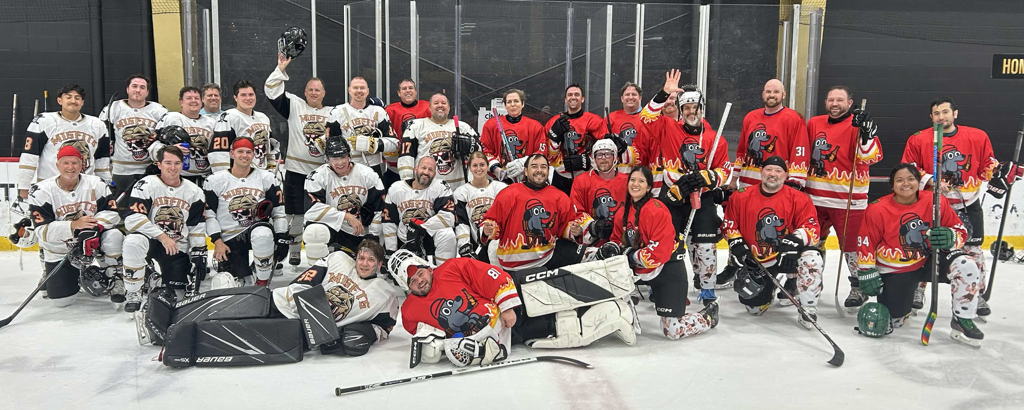
The final horn sounds, the gear bags come out and, pretty soon, somebody has a cooler open. For a lot of adult hockey players, that’s when another part of the night begins.
The parking lot is where teammates replay the game, chirp each other, share food and spend a little more time together before heading home.
And for Kelley Karas, that time off the ice has become one of the best parts of playing adult hockey.
Karas didn’t grow up playing the sport. In fact, she grew up in the desert and thinks she may have ice skated once before she turned 18.
Soccer was her sport. But she always liked watching hockey, and eventually that interest—along with her boyfriend’s love of the game—convinced her to learn how to skate.
“I learned to skate a couple years ago, built up the courage and took a few adult learn-to-play classes,” Karas said. “I’ve been playing organized adult hockey for a little over a year.”
These days, she plays E2 hockey two times a week: on Sunday nights at City National Arena in Las Vegas and D/E hockey on Tuesday nights in nearby Henderson.
Both of her teams—Friendly Fire and Lambs—were formed with newer players in mind. Once Karas got started, she got hooked.
“Starting and joining a team encouraged me to have my midlife crisis center around adult recreational sports,” she joked.
Toward the end of 2025, she decided she wanted to improve enough to really contribute to her team. So she started finding ice time wherever she could — classes, stick-and-pucks, pickup games, draft tournaments, roller hockey and anything else that fit into her schedule.
But not everything she values about hockey happens on the ice. For Karas, the postgame hangout matters just as much.
“It gives adults who have limited opportunities to make acquaintances and friends outside of work the opportunity to actually form positive connections and meaningful friendships,” she said. “I know that sounds goobery, but I’ve found it true.”
She has met plenty of people through hockey whom she otherwise probably never would have known.
And in her E2 league, hanging around is very much part of the experience.
“E2 is absolutely the league for parking lot hangouts during the other teams’ games,” Karas said. “We watch each other.”
Food is usually part of it. Karas describes the postgame spread as more of a potluck than anything organized.
“It’s a true buffet,” she said.
She has become known for bringing cheese boards with crackers and meats. Enough so that she has earned an unofficial title.
“I’m the cheese lady,” she said.
Apparently, the reputation has spread. During one game, a player from another team skated over toward the bench and chirped Karas by pretending to be a parrot asking for a cracker. Other teammates have their own specialties.
One teammate brings macarons and bakery treats. The captain is a reliable supplier of chips, plates and napkins. One of the goalies sometimes brings leftover baked goods from her children’s team.
Another teammate, who happens to be a fish biologist with a Traeger, occasionally grills.
“Basically, it’s a potluck,” Karas said. “People bring things to share and no one is afraid to enjoy.”
The food is fun, but it isn’t really the point.
The point is spending time together.
Sometimes teammates hang around to watch other games. Sometimes they organize additional 3-on-3 hockey with players from other teams.
They’ve gone to professional games together, met up at bars and restaurants after stick-and-pucks and even gotten together for pickleball.
There could be more pickleball coming.
“To be honest, probably more pickleball is on the list,” Karas said.
The group also tries to make sure people feel welcome.
“Everyone is invited to the games, our events, everything,” she said.
Karas doesn’t consider herself the loudest person in the room (or the parking lot) so she pays attention when somebody else seems quiet.
“If I see someone is quiet, I try to get them involved,” she said.
She thinks that atmosphere is part of what has drawn new players to the team.
“I think the players we’ve picked up—now in season three—gravitated toward our team and league because of the social environment.”
And those relationships can make a difference on the ice, too. Karas said spending time together has helped teammates see each other as more than just the people wearing the same jersey once a week.
“There is some level of care about each other as people versus just sports buddies,” she said.
They still talk hockey, of course. Postgame conversations often include what went well, what didn’t and what everyone can work on.
“We discuss personal and team hockey goals,” Karas said. “Our captains keep us focused and in line.”
Not every conversation is quite that productive. There was, for example, the great brie incident. One night, a teammate was eating from Karas’ cheese board. The options included brie, mozzarella, cheddar and Colby Jack. He grabbed the mozzarella. Then he kept telling everyone how good the brie was.
At first, everyone assumed he was joking. He wasn’t.
“It was very offensive to the Frenchman on our team,” Karas said, playing up the seriousness of the situation.
Those are the kinds of moments that become team stories.
And over time, those stories are part of what makes the team feel like a team.
There are also a few basic expectations when everyone hangs out.
The biggest one is simple.
“Clean up after yourself and leave the area cleaner than when you left it,” Karas said.
For example, one teammate, Stanton, has apparently taken responsibility for crushing all the cans.
And if somebody walking by seems interested, Karas said they’re welcome, too.
“There’s nothing wrong with making new acquaintances.”
For teams that don’t already have a postgame tradition, Karas doesn’t think it needs to be complicated.
You don’t need a full tailgate. You don’t need elaborate food. You don’t even have to do it after every game.
Just stick around.
“Not everyone does it,” she said. “You don’t have to do it all the time, but it does bring the team closer together.”
It probably won’t make anybody better at hockey, but it is worthwhile, Karas said. That same attitude carries over to her advice for adults who are thinking about trying hockey for the first time. There are plenty of ways to learn.
Karas has taken advantage of adult learn-to-play programs, skills classes, beginner skates, pickup games and other opportunities around the Las Vegas area. But the biggest thing is simply getting started.
“Absolutely do it,” she said. “And if you’re in Vegas, we have some great resources for you to get started.”
The hockey gets people onto the ice, but sometimes, it’s what happens afterward that turns teammates into friends.
