
The psychological impact of injury fears jeopardizing players’ World Cup aspirations
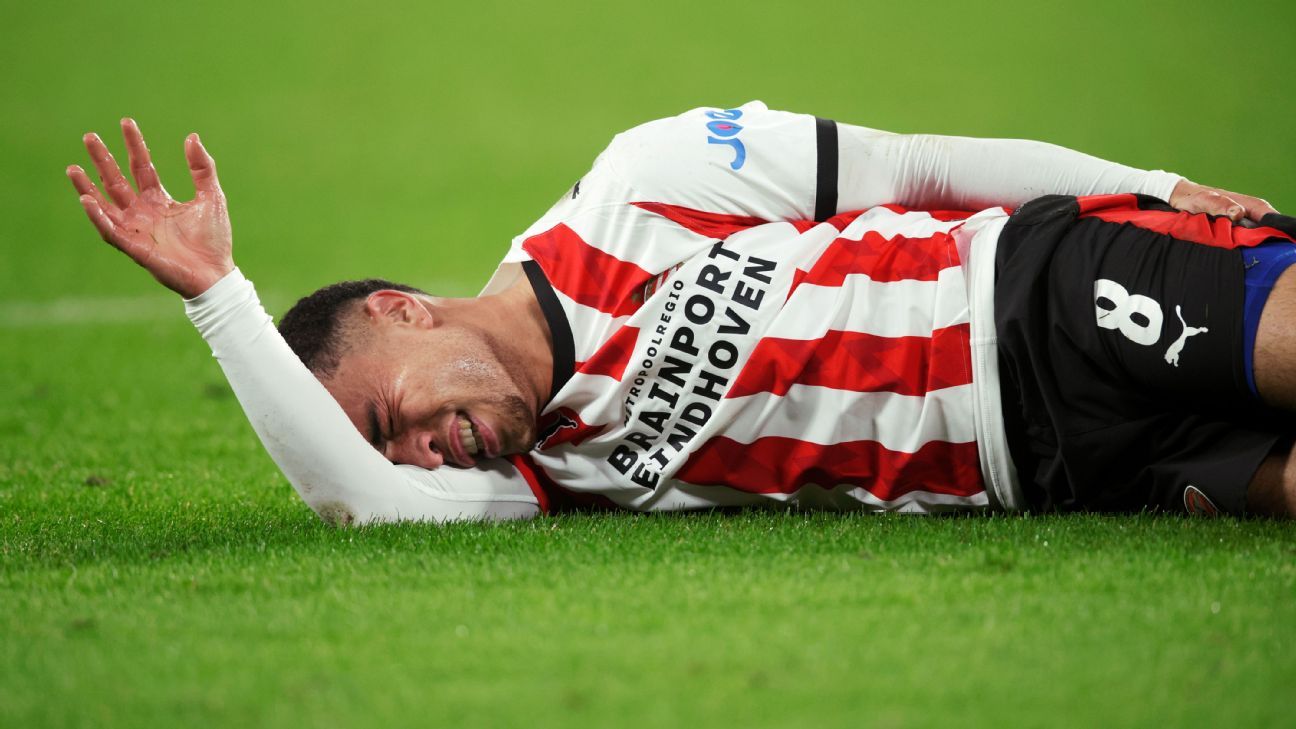
It represents the ultimate fear for any athlete. The most significant sporting occasion of their careers — such as a FIFA World Cup hosted in their own nation — is imminent. A lifetime of dedication is about to face its greatest challenge. Aspirations are on the verge of realization, and then an injury occurs.
Uncertainties arise. Will I recover? If I do, what will my performance level be? If I don’t, what happens next?
This can leave a player confronting a daunting reality.
This situation is one that many members of the U.S. men’s national team have faced over the past six months. PSV Eindhoven defender Sergiño Dest is racing against time to heal from a hamstring injury sustained on March 7, although he mentioned last Monday via the USMNT’s Instagram account, “I’m doing really well … I’m almost back.” AFC Bournemouth midfielder Tyler Adams has dealt with several injuries, including a torn MCL, since December, but he is currently back on the pitch.
Then there are injuries of a more severe nature.
Derby County forward Patrick Agyemang experienced a torn Achilles tendon on April 6. His aspirations for the World Cup, at least for this cycle, have been dashed.
So how does one manage — and recuperate — from these situations, particularly if participation in a major event like a World Cup remains a possibility? The process presents numerous challenges. There is the evident physical aspect, but for Dr. Jessica Bartley, who serves as the director of psychological services for the U.S. Olympic and Paralympic Committee and was previously involved with U.S. Soccer’s mental health task force, the psychological component is equally crucial.
“We’ve actually integrated psychology into every injury,” Bartley stated. “We have what’s called our athletes recovery program at the USOPC. And so psychology is a part of all of those components. We’re discussing athletes on timelines, and what do [they] think, and how do we position [them] in the best situation?”
The methods employed include mental imagery, visualization, and even virtual reality. Bartley added, “We are actually recognizing that mindset is incredibly powerful when you’re attempting to recover.”
The delicate balance surrounding injuries
The potential for injury looms like a shadow over every athlete — a sporting Grim Reaper, if you will — except in this case, the figure wields a scalpel instead of a scythe. This is particularly true at the professional level. Athletes essentially earn their living through their physical capabilities, dedicating countless hours to training to ensure they are in peak condition. Yet when preparing for a significant event, the mind and body remain interconnected.
“What’s been intriguing is the number of athletes now who engage in what we refer to as ‘prehab,'” Bartley noted. “That’s a way to get ahead of potential issues. There are numerous preventative measures that can be taken for both the body and the mind to position oneself optimally.”
It is likely that an athlete will face an injury at some point in their career. What results is an awkward mental dance where athletes attempt to avoid thinking about injuries, even while they take extreme measures to prevent them.
“[If] it’s something that you’re constantly thinking about, then it’s like destiny, right? It happens anyway,” remarked U.S. and Charlotte FC defender Tim Ream regarding injuries. “So yes, you try not to dwell on it, but you also understand that sometimes things occur.”
Indeed. Ream limped off at halftime during last weekend’s match against New York City FC due to a groin injury.
There are varying degrees of emotional reactions when an injury occurs, particularly concerning a player’s long-term prospects. When Adams injured his MCL in December, he outwardly displayed no concern about how it might impact his World Cup chances.
“I knew exactly what I did as soon as it happened,” Adams shared with ESPN. “Typical MCL; ball hits your toe, can’t really control it. And I just thought, ‘Yeah, I’ll be back in a couple months.’
Ricardo Pepi had a similar reaction. The PSV Eindhoven striker broke his arm in an unusual incident where he landed awkwardly during a game against Excelsior on January 10. Although there were brief moments when he considered the World Cup implications, he had more pressing concerns.
“It’s going to be something that worries you a little bit,” he told ESPN while reflecting on the injury. “But in the moment, you’re just really focused on getting back on the pitch as quickly as possible.”
However, injuries that are more prolonged or involve setbacks tend to impact the mind differently than shorter-term issues.
 play1:16Marcotti: Pochettino should want answers about Crocker’s resignation
Gab Marcotti discusses Matt Crocker’s decision to resign as sporting director of the U.S. Soccer Federation.
When U.S. and Fulham defender Antonee Robinson underwent surgery last May to address tendon calcification in his right knee, he believed he had ample time to recover. He was expected to return in time for the start of the Premier League season, but although he came back in late August, he soon found himself back on the bench, struggling to regain his physical form. The delay began to weigh on his mental state.
“There was a lot of concern, to be honest,” Robinson told reporters last month regarding whether he would be fit for the World Cup. “There was no certainty on my part that I would be ready and available, as it just felt like there was no light at the end of the tunnel.”
Robinson made significant progress in December and has been a regular presence in the Fulham and USMNT lineups since. Nonetheless, the mental strain of such an experience can be considerable for a player.
Confronting ‘the voice within your head’
Former U.S. international Stu Holden is well-acquainted with the emotional ups and downs that accompany an injury close to a World Cup.
In March 2010, Holden was on an upward trajectory. He was in the process of establishing himself in the first team at English club Bolton Wanderers, then in the Premier League, and had similarly done so with the USMNT. A significant role at that summer’s World Cup was within reach.
However, during a March friendly against the Netherlands, a reckless tackle from Nigel de Jong fractured the fibula in Holden’s right leg. Holden’s immediate response indicated the seriousness of the injury and the challenges that lay ahead.
“My instant reaction, my head’s in my hands. I know my World Cup is in jeopardy at that moment,” he told ESPN. “Straightaway that’s what I’m thinking about.”
Holden faced two choices: he could allow the bone to heal naturally, or he could opt for surgery to have a plate inserted to speed up the recovery process. With the 2010 World Cup in South Africa approaching, he chose the latter. Following the operation, Holden committed himself to his rehabilitation, but progress was slow. “I wasn’t myself,” he stated.
He returned to the Bolton lineup before the season concluded, but that was not the end of his recovery. When Holden reported for the USMNT’s pre-World Cup camp in Princeton, New Jersey, he realized he still wasn’t at full fitness.
He had always taken pride in his conditioning, and among USMNT players, he typically ranked in what he referred to as the “Tier 1 group” during fitness drills. That was true on the first day of camp, but he soon discovered he had fallen behind. The next day he was moved to Tier 2. The day after that, Tier 3. He was also continuing to experience significant pain in his leg, and the doubts about his ability to recover in time were very real.
“I always used to say the voice within your head, you’re battling yourself in those moments,” Holden remarked. “And I remember times when I was running by myself off to the side of the field. I likened it to being at Disneyland, but unable to go on any of the rides with your friends. You’re grinding.”
“And I remember saying like, ‘F— you, don’t let this slip away from you. This is your chance to make a World Cup. Dig deeper, push harder, don’t stop running.’ These are all the conversations you’re having with yourself, trying to motivate yourself, but it was all about the World Cup. That was everything and anything that was driving me through those challenging and difficult moments. That’s the reason you’re getting out of bed every day.”
Such internal dialogues are all too familiar to Bartley in her interactions with Olympic athletes. And journeys to Negative Town, like the one Holden experienced, aren’t necessarily detrimental. It’s a matter of doing whatever is needed in the moment.
“I will say that for the most part, [self-talk] is something really positive, but sometimes you might need to tell yourself like, ‘Don’t [mess] this up. Come on,'” she noted. “There are things you can say. And so I think it’s crucial to recognize that the self-talk needs to be credible, that it will motivate you and help push you through.”
Self-talk is merely one strategy that can be employed to foster a positive mindset. Athletes can also utilize affirmations, the support system around them, or routines to achieve that goal. Nowadays, finding that self-belief is increasingly challenging when footage of an athlete’s injury can be shared on YouTube or social media within moments. Bartley mentioned that viewing those videos and reliving those incidents can be traumatic for athletes.
“When we are inundated with all these images, we often have to reason through, ‘Look, that’s not going to happen,’ or ‘We’re doing this and we’re undergoing all of this rehabilitation. And honestly, the results indicate that you’re going to return stronger. It’s going to be nearly impossible for you to sustain the same injury if you do X, Y, and Z.’ A lot of times, I think of it as having to use science to counteract all of those fears.”
Success, followed by disappointment
Holden eventually reached a pivotal moment in his quest to secure a spot on the 2010 World Cup roster. He started a pre-World Cup friendly against Czechia, and his two set-piece deliveries contributed to both U.S. goals in a 4-2 defeat. Even after that match, he felt his chances of making the roster were “50-50.” However, then-manager Bob Bradley recognized enough potential to include Holden in the squad for South Africa. He even made an appearance at the World Cup, coming on as a late substitute against England.
As much as Holden’s talent earned him a place on the team, it was also his mental resilience that opened that World Cup door. The voice in his head provided the impetus he needed to recover.
“Talent gets you so far. The mentality at the top is what distinguishes the best from the very best. It’s this ability to navigate through challenging moments while maintaining incredible, unwavering self-belief,” Holden stated. “I believed in myself during that time. As much as I was like, ‘Oh, I don’t know, man,’ I knew I belonged. It was just that I had to continue to demonstrate that through my soccer, I think to myself, again, of a reminder of like, ‘Is my body failing me or am I there?’ And I think that was probably what I was experiencing at that training camp.”
Holden was not as fortunate during the 2014 cycle. In a reserve match against Everton in March, he re-injured the same ACL that he had hurt the previous year.
Then-manager Jürgen Klinsmann reached out to Holden afterward. “[Klinsmann] was incredibly important; he gave me hope,” Holden recalled. “He called me afterward and simply said, ‘I’m so sorry.’
History has shown that no team heading to the World Cup will be completely healthy. This applies to the U.S. as well.
In 2002, midfielder Chris Armas was unable to recover in time from a torn ACL to make the squad. Four years later, a knee injury sidelined defender Cory Gibbs after he had been named to the team. In 2022, it was a persistent hamstring injury that excluded defender Chris Richards.
However, there are also successes. Oguchi Onyewu recovered from a knee injury in 2010, and Weston McKennie did the same from a quad injury in 2022. Such is the nature of the sport. As the 2026 tournament approaches, the members of the USMNT will be hoping to evade the injury nightmare and realize their long-held aspirations.

